What happens if a nuclear warhead is launched accidentally
By Swastik Jain · · 1299 words
Topics: Physics, Tech, Apocolypse, atoms, Fire, India, NASA, nuclear
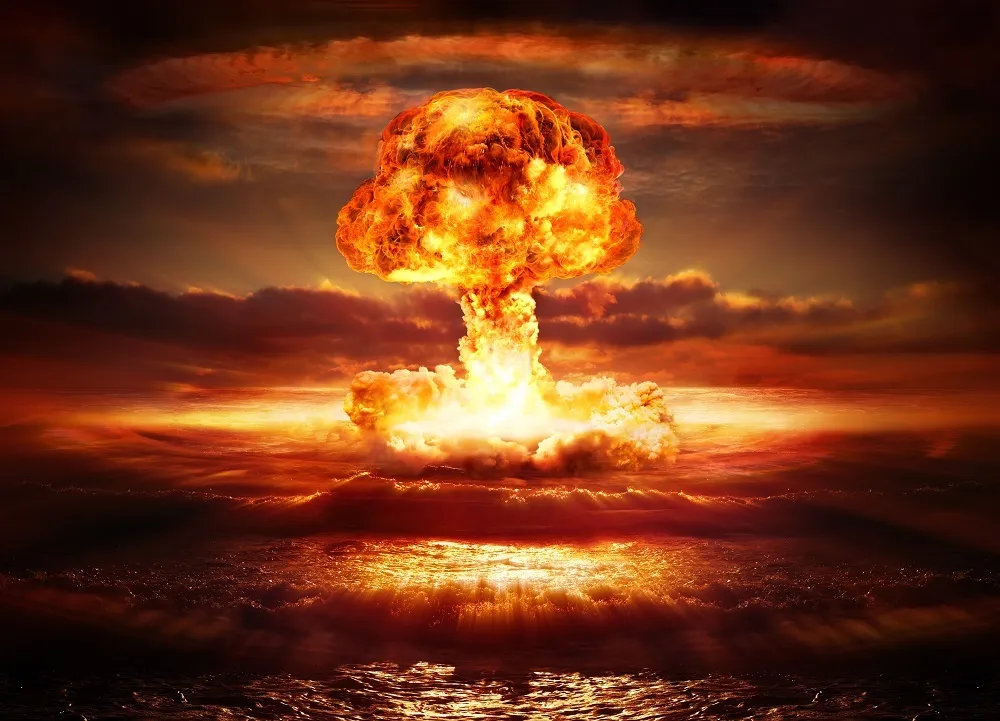
The most deplorable scenario, of launching a nuclear weapon by mistake, isn’t a dramatical sequence of a Hollywood villain smashing a glass case and pressing a “red button”. It’s a sleep deprived intern spilling a vanilla latte on some computer terminal by mistake (Unless a nihilist misanthrope). “If”, emphasizing again, “IF” a country accidently launched a nuclear weapon in the contemporary world, the immediate effect wouldn’t just be a geopolitical crisis but a highly embarrassing technical oopsies.
The first domino effect apparently takes place on Wall Street. Long before even a missile reaches the stratosphere, heat detecting satellites flag the rocket booster. In a fraction of a second, this data reaches high frequency trading algorithms. Before any word leader gets out of their sofa, completing the episode on Netflix, these signals trigger a global market crash. Billions if not Trillions of dollars is vanished just because the signals correctly identified that’s it’s a terrible time to hold stocks.
You must have heard about the legendary “Red Telephone”, in Hollywood of course, a phone that connects to some rival superpowers. In reality, no such phone exists. It is essentially a heavily encrypted, highly secure, chatroom. Then comes the impossible anticipation – an apology. The launching country would have about 20 minutes to fire off the most stressful message – “Hey Gang, my coffee just went full into some computer parts ig. completely my bad” Imagine the guy on the other side of the screen seeing this message, assuming a random folk just entered one of the world’s most secure places – by mistake; spilled coffee – by mistake; launched a nuclear weapon – by mistake; sent an apology – probably by mistake too.
You might wonder why they don’t hit the self destruct button. Hollywood lied to us, again. Real operational nuclear missiles don’t have one. The military realized that putting a button “Fold me like a lawn chair” on a live destructive weapon basically means inviting the adversary side hackers to safeguard themselves. Once a missile leaves, it’s a goodbye. If the targeted country actually manages to intercept the missile, the physical crater is avoided, but say Hello to Electromagnetic Pulse (EMP)! A high altitude detonation releases a massive wave of energy that instantly turns cars into crushed aluminum, cooks the power grid and completely wipes out telecommunication. Millions of people would survive completely unharmed, only to live with no WI-FI, navigating using physical paper maps, taking humanity centuries back.
Interestingly, in 1983, a Soviet officer named Stanislav Petrov saw his computer screen report 5 incoming missiles. Deciding the system was acting in an inaccurate manner, he completely ignored it. He averted danger by choosing not to do anything. Completely capturing the famous 5 star ad – Do Nothing.
Lets Approach this Technically
From a technical standpoint, launching a nuclear warhead is practically impossible as it has multiple safeguards
•Permissive Action Links(PALs): A warhead remains physically inert, that is, it requires a special code, often held by the highest authority in the government, for the missile to even launch.
•Environmental Sensing Devices (ESDs) are present which prevent the nuclear warhead to activate even when physically launched. These sensors detect environmental clues such as high G forces, the weightlessness of space and even heat due to re entry on earth , this is due to the fact that most warhead are launched via intercontinental ballistic missile (ICBMs) which go to very high altitudes and are very precise.
•It requires the authority and decision of multiple people in order to launch the warhead in the first place.
The Nightmare scenarios: No Turning back
Despite these immense pre-launch safeguards, the terrifying reality is that if a nuclear warhead were to launch and detonate, the consequences would be absolutely catastrophic.
Most nuclear missiles don’t have a self destruct or a recall button as to safeguard against jams, hacks or an attempt to neutralise the missile. This makes this scenario even more terrifying. Compounding this problem is the threat of automated retaliation. Certain nuclear-armed nations utilise secondary command networks—sometimes referred to in popular culture as a “dead man’s switch” system. If the centralised leadership is wiped out in a first strike and fails to check in or suppress the system at regular intervals, pre-delegated retaliation protocols can automatically trigger the launch of remaining warheads.
Phase 1: The Detonation
The actual warhead is relatively small at about 1m inside the missile. Just within a few microseconds the conventional explosives will trigger and compress the plutonium core, triggering the actual nuclear fission or fusion.
Temperatures instantly reach 100 million degrees Celsius (hotter than the centre of the sun). The warhead metal immediately vaporises into a plasma core.
Phase 2: Microseconds to Milliseconds (The Flash)
The fireball engulfing everything expands to 300m in less than 0.1 second.
The superheated plasma emits intense soft X-rays. The air absorbs these X-rays, turning the surrounding atmosphere into a glowing, expanding fireball. A blinding thermal flash propagates outward at the speed of light, carrying 35% of the bomb’s total energy.
Phase 3: At exactly 1 second (Peak)
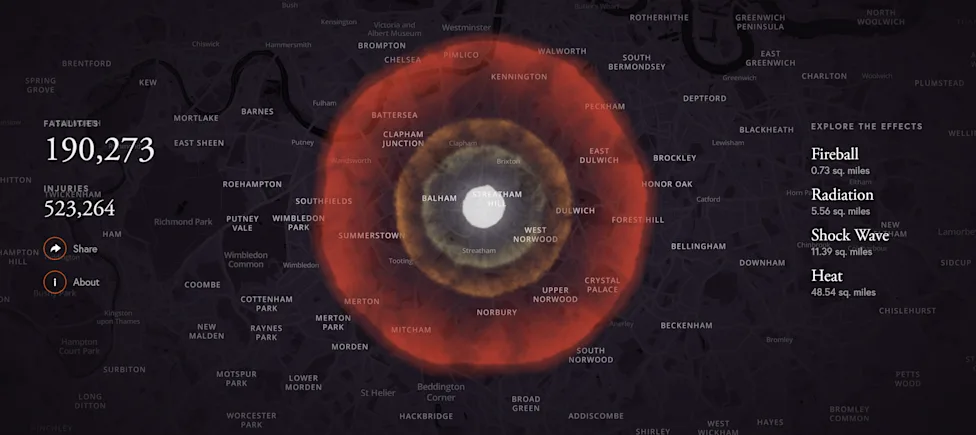
At exactly 1 second, the explosion looks like a massive, terrifying second sun sitting on the horizon.The fireball reaches a radius of 800m and the blast radius is anywhere around 1 km.The blast shockwave—a compressed wall of air traveling faster than the speed of sound—”breaks away” from the surface of the fireball.Right behind this shockwave are blast winds reaching speeds up to 1,000 km/h. Inside this 1-second radius, reinforced concrete structures are completely pulverized into deep piles of rubble.
Phase 4: Aftershock:-
After 5-10 seconds of detonation, the fireball’s intensity slows and it begins to fade away and the blast radius has now reached 3-5km.
The shockwave continues to march outward, shattering glass, overturning vehicles, and flattening standard residential homes miles away. The rising fireball creates a vacuum beneath it, drawing in air, smoke, and dirt from the ground, which begins forming the classic mushroom cloud.
Immediate aftermath (15mins-24hours)
The immediate blast and thermal effects conclude but there is still very hazardous amounts of radiation.
The dirt, debris, and vaporised buildings sucked up by the rising mushroom cloud become highly radioactive. As these particles cool, they fuse with fission products.The wind carries this debris downward, making it seem is its raining ash and dirt.
Lethal Radiation Zone: Within a few hours, areas dozens of kilometres downwind receive intense gamma radiation(exceeding 600 rads). Anyone exposed in this zone without thick shielding suffers severe Acute Radiation Syndrome (ARS) and dies within days.
The global Aftermath: Nuclear winter (months to years)
The explosion triggered widespread environmental disruptions and made the detonation area highly toxic for years and years to come. If multiple nuclear warheads they will cause a phenomenon known as nuclear winter.
Nuclear Winter: Millions and millions of tonnes of black carbon (soot) rise high into the stratosphere and circle the earth. Due all the debris blocking the sunlight, the planet plunges into a prolonged twilight.
•Global Freeze: Global temperatures drop drastically. In a full-scale war scenario, average surface temperatures drop by 8°C to 15°C globally, and by up to 20°C to 30°C in the interiors of North America and Eurasia. Summer effectively vanishes in agricultural heartlands, replaced by killing frosts.
•Global Famine: Because crops cannot grow without sunlight and warmth, global food production collapses. Modern climate and agricultural models estimate that a full-scale nuclear winter would trigger a global famine, threatening the survival of billions of people worldwide due to starvation rather than the initial blasts.
•Ozone Layer Destruction: As the soot heats the upper atmosphere, nitrogen oxides destroy the ozone layer. Years later, when the soot finally clears, the surface of the Earth is bombarded with extreme levels of dangerous ultraviolet (UV) radiation, blinding animals and blistering remaining crops.