New memory breakthrough where bio meets tech
By ADMIN · · 479 words
Topics: Physics, Tech, AI Data Centers, AI Research, Artificial Intelligence, Brain Cells, Brain chip, chip
Currently, we are facing a memory crisis due to AI and next-gen tech. Current computers waste 80% of the energy shuffling data between memory and processing units. This puts a wall for further development if we keep using traditional computing systems.
To solve this problem, scientists and researches have been trying to develop a chip that works like our brain – where processing and storing memory happens at the same place: neuron.
Now, at Penn state university have done exactly that by marrying two completely different worlds: synthetic DNA and perovskite semiconductors. Published in Advanced Functional Materials, this new bio-hybrid memory chip isn’t just a minor upgrade. It’s a radical leap forward that could slash computing energy demands by up to 100 times.
The fusion of glass canon and coating: Perovskite meets DNA
To build a brain-like chip (known as a memristor), you need materials that can easily change and hold their electrical resistance states.
The glass cannon: Perovskite are next-gen semiconductors which are very powerful on their own. They are highly efficient at conducting electricity and manipulating ions but they have a fatal flaw : they are fragile and degrade quickly.
The coating: DNA is the foundation of life. How a protein would fold is dictated by DNA thus DNA controls all functions of the body. DNA has a unique structure which is very durable.
The Fusion: Researchers engineered a custom, 22-mer synthetic DNA sequence and doped it with silver nanoparticles. When combined, the DNA acts as a rigid, highly organised structural framework. It stabilises the delicate perovskite and creates nanoscale conductive channels for electrons to flow through.
When a tiny voltage or current is applied, the perovskite manipulates the charge where the DNA acts like the ultimate active switch. They work in perfect harmony to store data without needing constant stream of power.
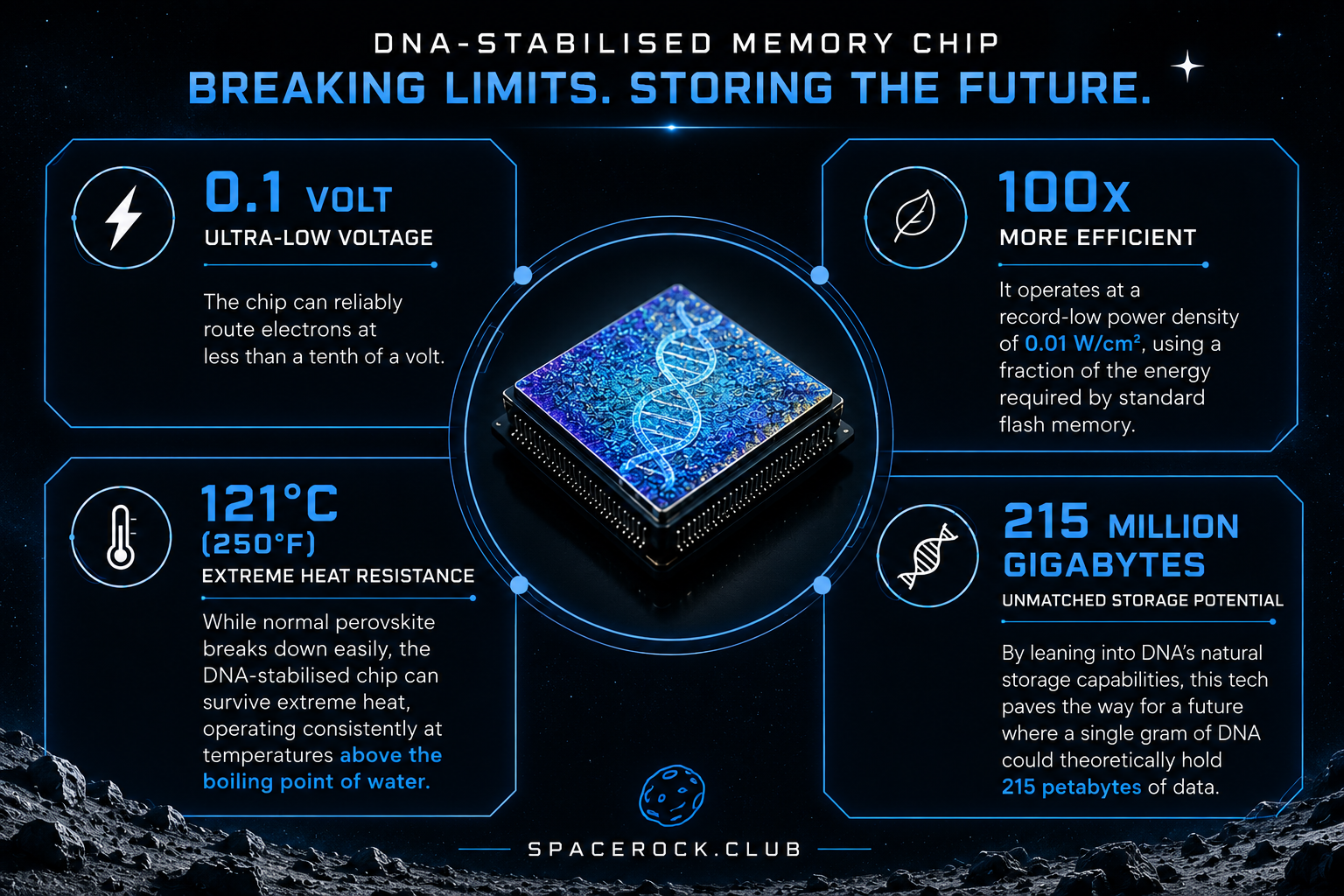
The mind-breaking stats
The results of this natural-unnatural fusion is a breakthrough in modern chips
Why this is important for the future
Right now, large AI data centers are straining power grids, monopolising memory and requiring massive cooling systems. They are restricted by traditional “Von Neumann” computer architecture, which separates the “thinking” (CPU/GPU) from the “remembering” (RAM/Hard Drive).
Because the DNA-perovskite chip is a memristor, it enables neuromorphic computing. Since it mimics human brain processing, the processing will happen in the storage medium itself.
By eliminating the data commute, we can train and run massive AI models locally on smaller devices, with a fraction of the power footprint.
The Road Ahead
While we won’t see bio-hybrid chips in computing systems next month, this breakthrough blurs the line between biology and computing. This will pave the way for more such advancements in tech and the improvement in bio-tech systems.By using nature’s most efficient storage molecule to stabilize tomorrow’s advanced semiconductors, we are finally building hardware capable of keeping up with the AI revolution.