IceCube is the craziest telescope ft. Nobel Francis Halzen
By Nitai Garg · · 587 words
Topics: Physics, Tech, AI, Antarctica, astrophysics, atom, atomic, black hole
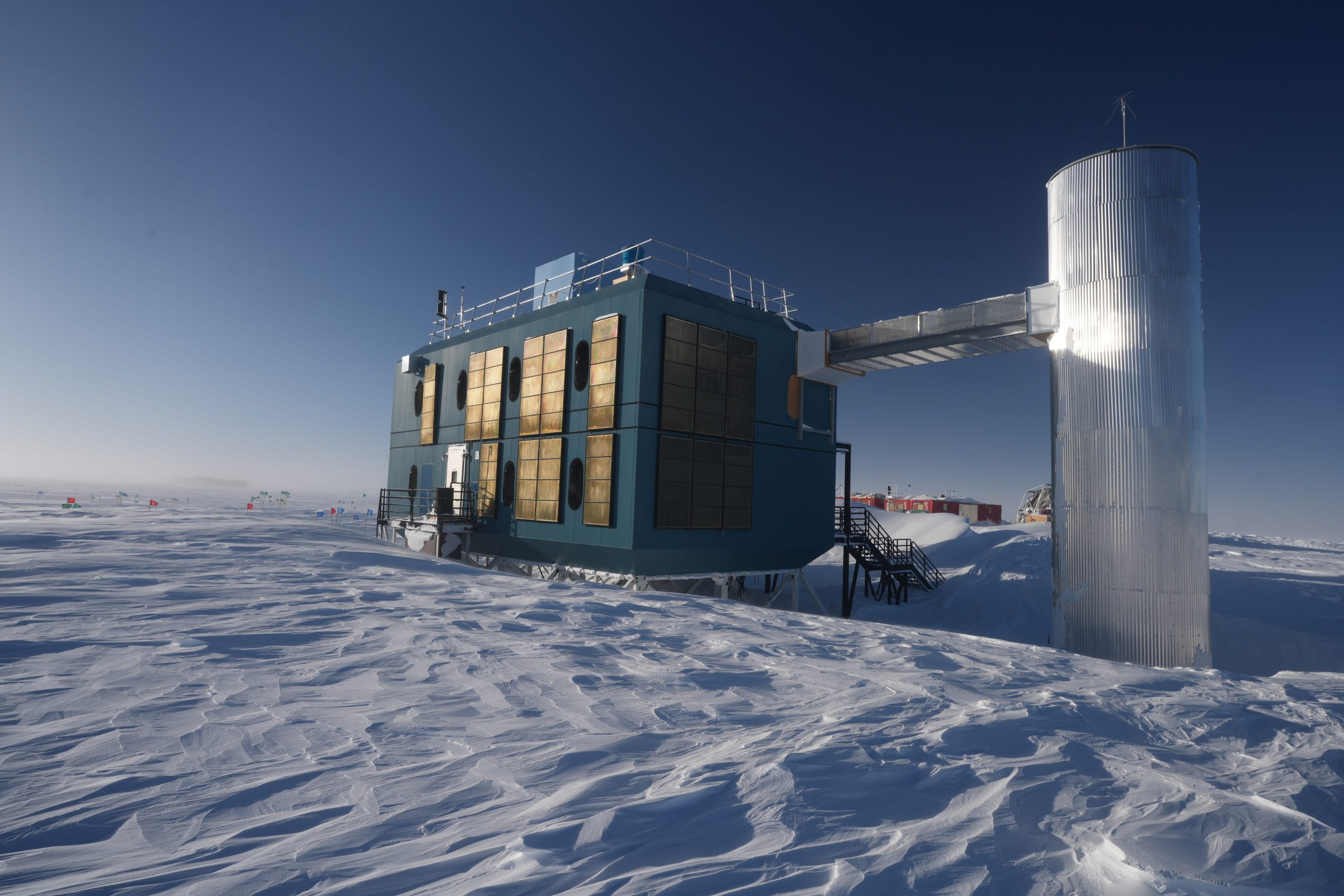
When we think of astronomy, we think of looking up with various tools such as giant telescopes, refracting mirrors and space telescopes that points towards the never-ending expanse of space. But earlier this week, on October 6, 2026, the Royal Swedish Academy of Sciences awarded the 2026 Nobel Prize in Physics to a telescope that does not point towards space, sits 2 kilometers deep the earth’s surface between ice caps in Antarctica, and is an IceCube??

The sole winner for the noble prize is Francis Halzen, an 82 year old physicist from the university of Wisconsin-Madison. His accomplishment? Turning kilometers of deep glacial ice of Antarctica into world’s craziest telescope named IceCube Neutrino Observatory.
For years we have detected high energy protons emitted from across the space known as cosmic rays which have energy 1000 times more of what the Large Hadron Collider(LHC) can produce. But we can’t trace their origin because due to the long distance, their paths bend due to various electromagnetic fields present in space.
Here enters the “Ghost Particle” 👻 : Neutrinos
Neutrinos are small particles that do not interact with normal matter or light. Billions of these neutrinos are traveling through you and you don’t feel them at all. They have no charge and have negligible mass: consider a million times less than an electron. Thus they don’t interact with with electric and magnetic fields of space and we can trace their source in a straight line. Every cosmic object emits them such as black holes, galaxies and large nebulas forming millions of stars. Even our sun produce billions of neutrinos
But that also poses the problem of them being not detected by traditional equipments. So researching on them is quite difficult but there is a way.
How are they detected?
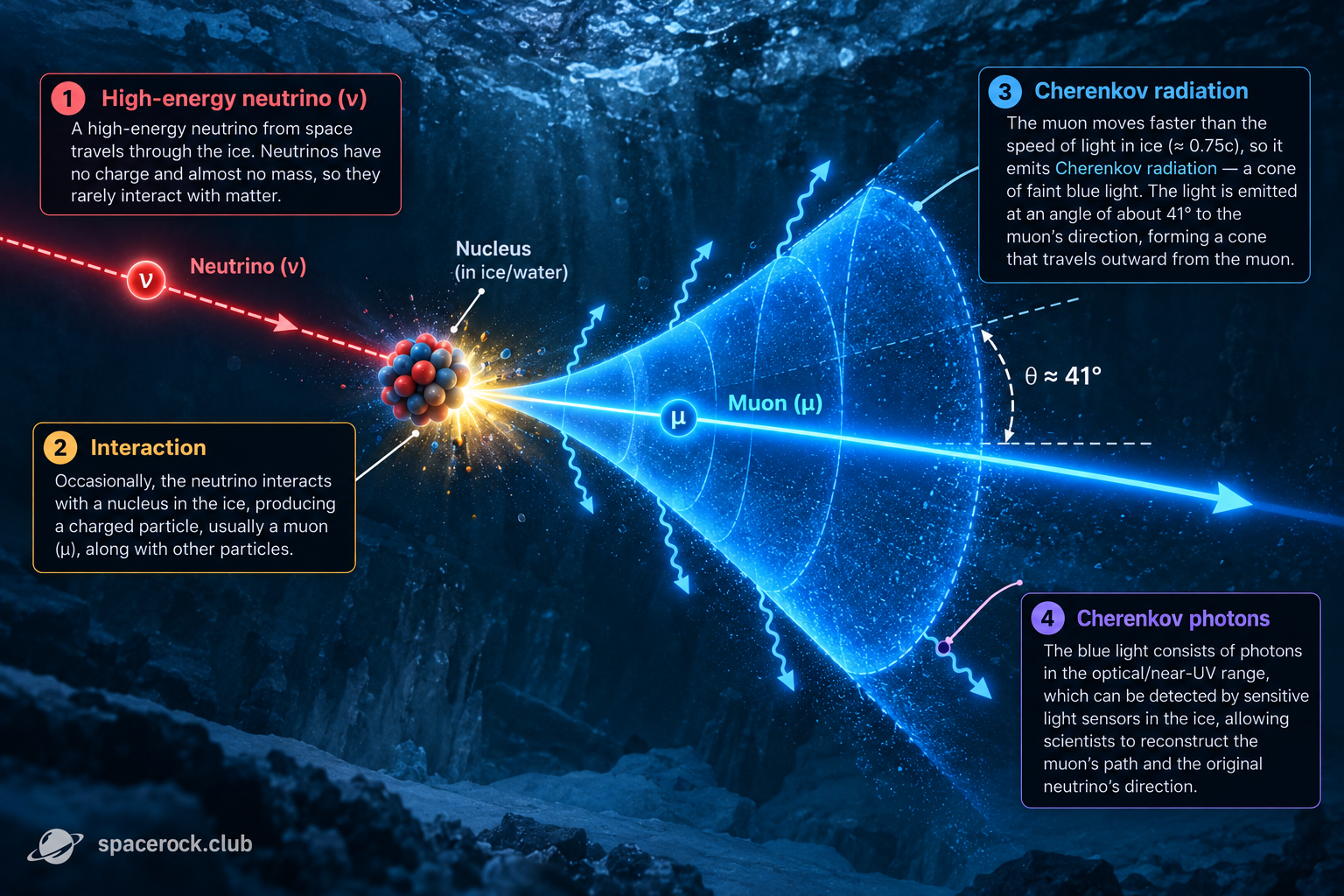
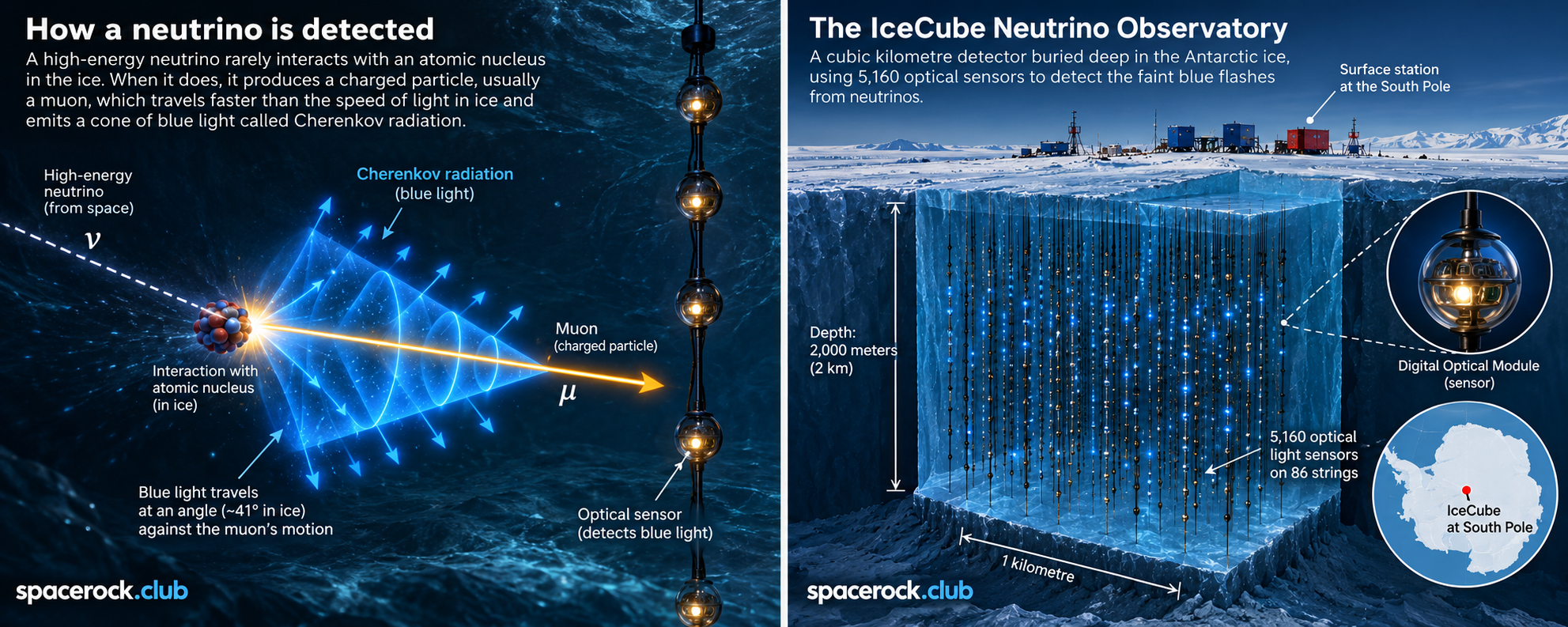
When a high energy neutrino strikes a atomic nuclei in water, a charge particle get released. This particle is Muon, If this Muon moves faster than the speed of light inside the water, it creates a faint, ghostly blue cone of light known as Cherenkov radiation. The sensors catch this blue flash, allowing scientists to calculate exactly where the neutrino came from.
Here comes the Giant Ice Cube
The IceCube Neutrino Observatory proposed in 1988 by Francis Halzen, finished in 2011. The idea was simple, Antarctica already has the ready available ice for the sensors to be placed. The IceCube just a literal 1 cubic km of ice equipped with sensors. This observatory has the group effort of over 450 plus scientists from across 14 countries.
Scientists used hot water drills to dig deep Into the Antarctic glaciers to put the sensors. In total, 5,160 optical light sensors hang like lanterns on long vertical strings frozen deep under the South Pole in total darkness.
As neutrinos arrive, they collide and generate Muon which emits the blue flash which then the sensors can use to backtrack the source. This observatory catches neutrinos 1000 times more energetic compared to what the Large Hadron Collider(LHC) at CERN could detect.
Major Discoveries
1.Traced a neutrino back to a 3.7 billion light year away blazar(radiation emitting black hole) pointed directly towards earth in the year 2017
2.Mapped the Milky Way using neutrinos instead of light, revealing the high-energy radioactive underbelly of our own galaxy.
Francis Halzen spent decades defending a project that many thought would never work. As he beautifully put it this week: “Space has been sending us messages all along. We just had to build the ear to hear them.”